Configuring battery-powered tables for commercial workspaces
A battery-powered meeting table is a commercial table with integrated rechargeable power, allowing users to charge devices without relying on floor boxes. They can be configured individually for boardrooms, linked for training spaces, or flipped and stored to create flexible collaborative workspaces depending on specific project requirements.
Modern meeting spaces are expected to do more than host a single type of event. The same room may need to support board-level presentations, hybrid calls, training sessions, and collaborative workshops. These activities often require completely different layouts across the same week.
That level of adaptability is difficult to achieve when power is tied to fixed floor boxes, wall sockets, or visible cabling. Once a table must be tethered to a specific spot for power, the layout quickly becomes fixed. Configurable meeting tables solve this challenge by bringing rechargeable power directly into the furniture. This allows the room to adapt without compromising access to charging, the visual finish, or the user experience.
As battery-powered office furniture becomes more visible in the market, specifiers need to look carefully at how each system works in practice. This guide explores how configurable layouts support different commercial environments, helping architects, designers, and facilities managers specify the right solutions for their projects.

How can battery-powered tables be configured?
Battery-powered meeting tables offer immense flexibility for commercial fit-outs. They can be used individually, linked together, moved between layouts, or flipped and stored depending on the workspace requirement. The best solution is not simply the table with the largest battery, but the system that best fits how the space will actually be used.
Specifying for the premium boardroom
A boardroom requires a high level of visual refinement. When specifying a battery-powered meeting table for executive spaces, the design intent must remain the priority. A cableless meeting table helps maintain a clean aesthetic by eliminating unsightly trailing cables and floor boxes.
For larger executive groups, linking tables are often required. Specifiers should look for systems that allow tables to join seamlessly while maintaining consistent power access across the entire surface. Finish quality is equally important. Choosing premium materials like wood veneer or Fenix ensures the furniture feels appropriate for high-quality interiors.
Adapting training spaces with flip-top tables
Training rooms demand frequent reconfiguration. A space might host a classroom-style seminar in the morning and transition into an open floor for group exercises by the afternoon.
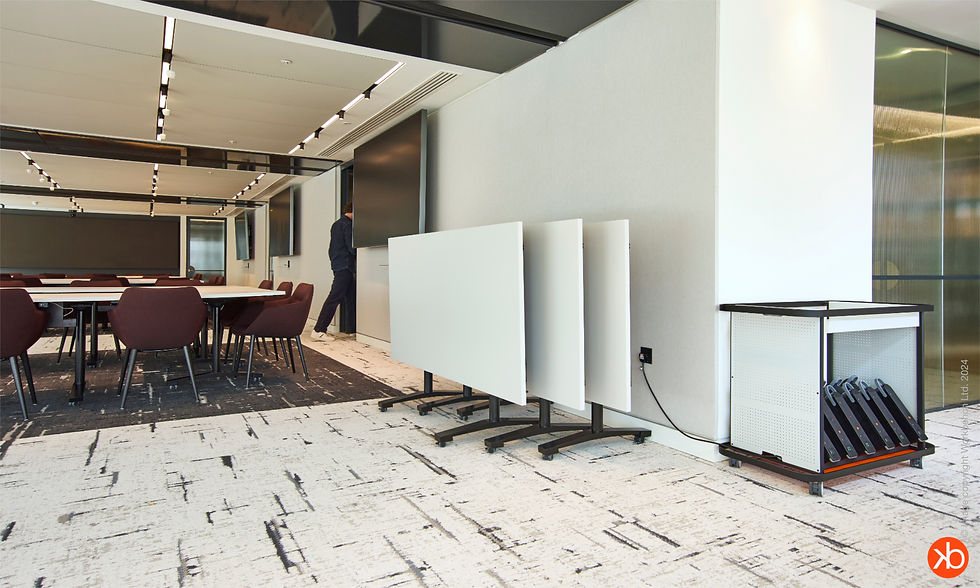
Flip-top tables are highly effective in these environments. When equipped with mobile castors and rechargeable power, these tables can be rolled into position, locked in place, and used immediately. When the session ends, facilities teams can easily flip the tops and nest the tables together at the edge of the room. This operational practicality reduces friction and saves valuable time for facilities management teams.
Designing a flexible collaborative workspace
Project rooms and collaborative workspaces thrive on agility. Teams often need to form small clusters, break apart for focused work, and reconvene for client presentations.
Configurable meeting tables support this dynamic workflow. Users can easily pull two or three tables together to form a larger project bench. Integrated USB-C charging ensures that laptops and phones stay powered throughout long collaborative sessions. By removing the dependency on floor boxes, these tables allow meeting spaces to be planned around people, purpose, and movement.
Introducing Air Atoll for commercial workspaces
Air Atoll is Workbench's established battery-powered, mobile flip-top meeting table system for flexible commercial spaces. Designed and manufactured by Workbench, Air Atoll combines rechargeable battery power, mobile flip-top functionality, linking configurations, and integrated charging access.
The Air Atoll system uses existing cutting-edge battery technologies concealed within a sleek frame. This setup feeds perfectly positioned USB-C charge points or optional power outlets at the perimeter of the table. A recent design enhancement introduced a new double-column frame configuration that supports tabletops up to 3000 mm x 1500 mm.
For facilities teams, Air Atoll includes a stylish mobile charging trolley. This allows for the simultaneous transport and charging of multiple batteries, ensuring there are always replenished power banks available for daily operations.
Checklist for specifying a battery-powered table system
When planning a flexible meeting room, specifiers should evaluate several practical decision criteria.
Choose a mobile flip-top table if your primary goal is rapid room reconfiguration and easy storage.
Choose linking tables if you need to create continuous, large-scale boardroom setups that still offer individual power access.
Prioritise a robust battery management system (such as a dedicated charging trolley) if your facilities team needs to support multiple rooms in a large commercial office.
Select tailored finishes (such as Fenix or veneer) if the design intent requires the furniture to match a premium architectural fit-out.
Frequently asked questions about configurable meeting tables
What is a battery-powered meeting table?
A battery-powered meeting table is a commercial table with integrated rechargeable power. It allows users to charge laptops, phones, and other devices without relying on fixed mains cabling or floor boxes.
How long does a rechargeable meeting table last before needing to be charged?
The battery life depends on the specific system and usage rates. High-quality systems are engineered to power multiple laptops and mobile devices for several hours, easily covering a full day of typical meeting room use.
Are cableless meeting tables easy to move?
Yes. Systems designed with mobile flip-top functionality feature castors that allow facilities teams or end users to roll the tables into different configurations easily.
Can configurable meeting tables be linked together?
Yes. Many premium systems, including Air Atoll, are designed to function as linking tables. This allows multiple units to join together securely to form larger boardroom or project configurations.
How are the batteries recharged?
In a resolved commercial system, the batteries are typically removed from the table and placed into a dedicated charging trolley or base station. This allows the tables to remain in use while spare batteries are charged centrally.
Plan your next commercial workspace with Workbench
A flexible workspace is only truly adaptable if the furniture can move with it. Battery-powered meeting tables offer a practical, visually clean way to support modern work without the limitations of fixed infrastructure.
Speak to Workbench about specifying Air Atoll for your next commercial workspace project. Our team can help you configure a complete battery-powered table system tailored to your specific project requirements.
Furniture solutions by Workbench
Designed by us, tailored by you.
Discover more about Air Atoll here...