Why battery-powered office furniture needs more than a battery
A battery cell alone cannot support a flexible commercial workspace. A complete battery-powered office furniture system requires integrated power outlets, discreet USB-C charging, concealed cable management, and a practical charging trolley workflow to ensure long-term performance, safety, and visual refinement in premium meeting rooms.
Modern meeting spaces are expected to do more than host a single type of meeting. The same room may need to support board-level presentations, hybrid calls, training sessions, project work, and collaborative workshops, often with different layouts across the same week.
That level of flexibility is difficult when power is tied to floor boxes, wall sockets, or visible cabling. Battery-powered office furniture solves this by bringing rechargeable power directly into the furniture, allowing the room to adapt without compromising access to charging, the visual finish, or the user experience.
As interest in battery-powered meeting tables grows, specifiers need to look carefully at how each system works in practice. The presence of a battery is only one part of the decision. Power access, battery management, mobility, cable integration, finish quality, and long-term support all shape whether the table will perform in a commercial setting.
Why is battery-powered office furniture growing in commercial workspaces?
Facilities managers and workplace consultants understand that hybrid work requires adaptable room layouts. When a meeting table relies on a fixed mains connection, the furniture must sit exactly where the floor box is located. This restricts how a space is used.
Cableless meeting tables remove this dependency. They allow architects and interior designers to plan spaces around people and purpose rather than fixed power infrastructure. By removing the dependency on floor boxes, meeting spaces can be reconfigured rapidly. This approach also has significant benefits for listed buildings, where the introduction of mechanical and electrical services is often disruptive, costly, or simply not possible.
Why the battery cell alone is not enough for commercial interiors
It is tempting to view a battery cell as a complete solution. However, attaching a power pack to the underside of a standard table does not create a functional piece of commercial furniture. A fully resolved system must address power delivery, user safety, and operational practicality. When comparing powered meeting table options, specifiers should consider the overall furniture architecture.
How does integrated power and USB-C charging improve user experience?
The primary purpose of a powered meeting table is to keep laptops and mobile phones charged during long meetings. If the power outlets are difficult to reach or visually disruptive, the user experience suffers.
A considered design integrates technology quietly. Discreetly mounted twin USB-C charging points or dedicated power outlets should be easily accessible at the table edge. This gives users access to power exactly where they are working, rather than forcing them to reach under the table or stretch cables across the work surface.
Why is cable management critical for battery-powered office furniture?
A cableless meeting table must genuinely eliminate trailing wires. If a battery pack simply replaces a floor box but still requires loose cables draped across the table surface, it fails to solve the core problem.
Premium solutions feature concealed cable management. They route power directly from the battery cell to the surface power outlets without exposing wires. This approach maintains the clean lines expected in a premium interior, ensuring the technology supports the design intent rather than detracting from it.

How do charging trolleys support facilities management workflows?
For facilities teams, the value of a battery-powered meeting table is not only in removing cables. It is in creating a repeatable, manageable way to keep rooms powered throughout the working day. A standalone battery is useless if it is difficult to recharge.
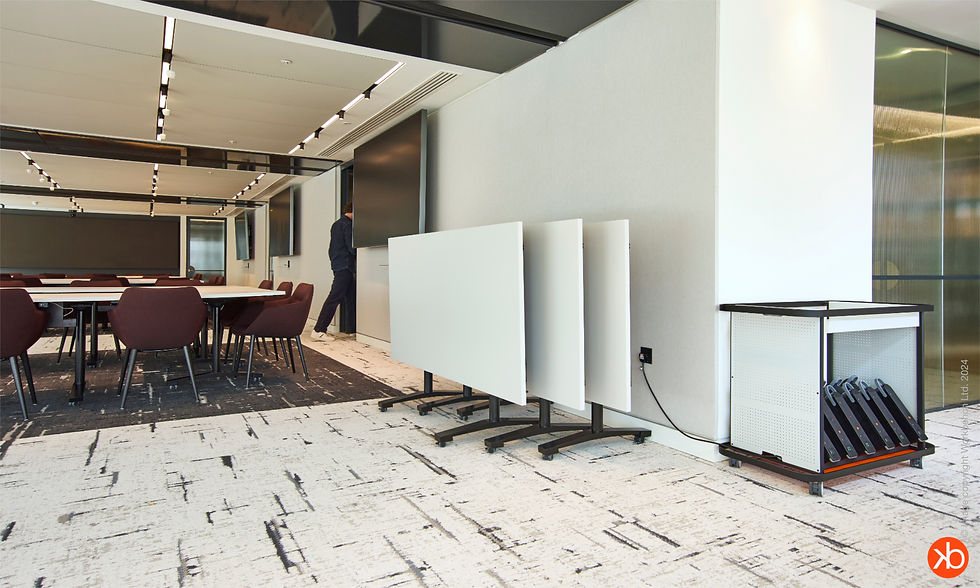
A stylish mobile charging trolley provides a systematic way to transport and simultaneously replenish multiple batteries. This ensures that fully charged batteries are always available for quick exchange, reducing operational friction and keeping the room powered.
How does Air Atoll integrate power and furniture design?
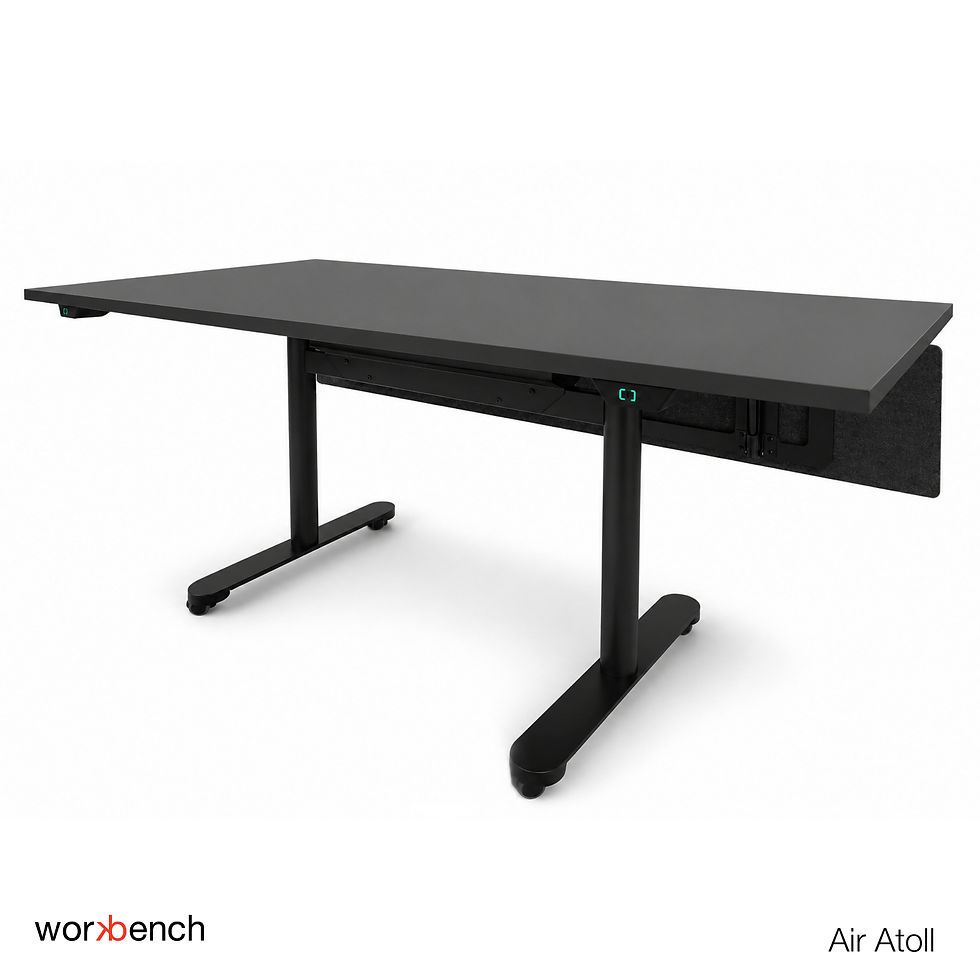
Air Atoll is Workbench's established battery-powered, mobile flip-top meeting table system for flexible commercial spaces. It allows meeting rooms, boardrooms, and training environments to access integrated power without relying on floor boxes, fixed mains connections, or visible trailing cables.
Designed and manufactured by Workbench, Air Atoll combines rechargeable battery power, mobile flip-top functionality, linking configurations, and integrated charging access. It gives commercial meeting spaces a practical way to support devices without allowing fixed power infrastructure to dictate the room layout. Recent enhancements include a revised battery orientation to optimise power delivery and streamlined power distribution to the table edge.
Air Atoll is available in a range of standard sizes and finishes, including Fenix, laminate, and veneer. Furthermore, a new double-column frame configuration supports table tops up to 3000 mm x 1500 mm, expanding the table's capabilities for larger spaces.
Sustainability is part of the specification conversation. For commercial projects, the value lies not only in the materials chosen but also in how well the furniture supports long-term use, future reconfiguration, and responsible sourcing requirements. Air Atoll embraces circular design, allowing components to be swapped out on a part-by-part basis without replacing the whole table. By specifying Air Atoll, businesses choose a proven system developed through real-world workplace use.
What are the key criteria for specifying a battery-powered meeting table?
When specifying a battery-powered meeting table, the first question should be how the room needs to work. A boardroom, training room, and collaboration space may all require access to power, but they will not use the table in the same way. Consider these decision criteria when evaluating options:
Choose a system with a dedicated charging trolley if your facilities team needs to manage multiple rooms efficiently.
Choose integrated USB-C charging at the table edge if users primarily need to charge laptops and phones during short collaborative sessions.
Choose a mobile flip-top table design if the room layout needs to change frequently to accommodate different activities.
Choose a table with concealed cable management and high-quality finishes (such as veneer) if the furniture is intended for an executive boardroom.
The best solution is not simply the table with the largest battery, but the system that best fits how the space will be used.
Moving beyond the battery in commercial workspaces
A meeting room is only flexible if the furniture can move with it. Battery-powered office furniture offers a clear path away from restrictive floor boxes, but only if the furniture is designed as a complete system. Power, mobility, charging workflow, and long-term use all need to be considered carefully. A fully resolved product ensures that the room remains visually clean, the table remains easy to use, and the facilities team can manage the technology without disruption.
Speak to Workbench about specifying Air Atoll for your next commercial workspace project. Ask the Workbench team about integrating rechargeable power into your meeting table specification to support flexible, premium interiors.
Frequently asked questions
What is a battery-powered meeting table?
A battery-powered meeting table is a commercial meeting table with integrated rechargeable power. It allows users to charge laptops, phones, and other devices without relying on floor boxes, wall sockets, or fixed mains cabling.
How do you recharge battery-powered office furniture?
The most efficient method utilises a mobile charging trolley. Facilities teams can unclip the depleted battery cell from the table, place it in the trolley for recharging, and immediately swap in a fully charged battery to maintain continuous power.
Are cableless meeting tables suitable for executive boardrooms?
Yes. Premium battery-powered tables like Air Atoll offer high-quality finishes, including veneer and Fenix. They integrate technology discreetly with concealed cable management, ensuring the furniture meets the visual standards required for boardrooms and executive spaces.
Can battery-powered meeting tables be linked together?
Yes. Advanced systems allow individual tables to link together to form larger collaborative environments or boardroom setups. Each table maintains its own power supply, ensuring that all users have access to integrated power outlets regardless of the configuration.