How rechargeable meeting tables support hybrid workspaces
A rechargeable meeting table is a commercial meeting table with an integrated battery. It allows users to charge laptops and mobile devices without relying on fixed floor boxes or visible mains cabling. This provides architects and facilities teams with the freedom to reconfigure room layouts in hybrid commercial workspaces quickly.
Modern meeting spaces are expected to do more than host a single type of meeting. The same room may need to support board-level presentations, hybrid video calls, training sessions and collaborative project work, often with completely different layouts across the same week. Facilities teams and office managers are constantly asked to adapt spaces to fit the changing needs of the workforce.
That level of adaptability is incredibly difficult when power access is tied to floor boxes, wall sockets or visible trailing cables. If the furniture must remain tethered to the building's fixed infrastructure, the room layout quickly becomes static.
Battery-powered meeting tables solve this challenge by delivering power directly to the furniture. This allows the room to adapt to any requirement without compromising access to charging, the visual finish or the overall user experience.

What is a rechargeable meeting table?
A rechargeable meeting table is a commercial table system equipped with built-in battery packs that distribute power to users. Instead of plugging the table into a floor box, the table operates independently using concealed lithium batteries. These systems typically provide USB-C power and standard outlets directly at the table edge.
As interest in battery-powered meeting tables grows, specifiers need to look carefully at how each system works in practice. The presence of a battery is only one part of the decision. Power access, battery management, mobility, cable integration and finish quality all shape whether the table will perform in a demanding commercial setting.
How flexible workspace furniture adapts to changing room use
Hybrid work has fundamentally changed how commercial offices function. Employees now come into the office specifically for collaboration, workshops and team alignment. As a result, the static boardroom is often replaced by multi-purpose spaces.
When power is tied to floor boxes, changing a room layout requires complex cable management and often introduces trip hazards. A cableless meeting table allows facilities managers and interior designers to plan spaces around people, purpose and movement. You can position the furniture wherever it best serves the team, knowing that device charging demand is fully supported.
By removing the dependency on fixed infrastructure, flexible workspace furniture reduces operational friction. Rooms can shift from a theatre-style training setup in the morning to a collaborative pod configuration in the afternoon, all without calling in an AV or maintenance team to manage power cables.
Why does device charging demand require a mobile meeting table
Virtually every meeting today involves a laptop, a mobile phone or a tablet. Hybrid video calls drain battery life quickly, making accessible power a basic requirement for any commercial workspace.
A laptop charging table ensures that users have immediate access to power exactly where they sit. The strongest powered meeting tables do not make technology the focal point. They integrate it quietly, so the room remains visually clean and the table remains highly functional.
Integrated USB-C charging gives users access to power wherever they work, rather than forcing the room layout to accommodate wall socket locations. This keeps power access close to the user while concealing the complex cable architecture within the table's frame.
Use cases across meetings, workshops and calls
A fully resolved battery-powered meeting table system seamlessly supports multiple commercial functions. Consider how different scenarios benefit from cableless power:
Hybrid video calls: Mobile meeting tables can be positioned to optimise camera angles and screen visibility, rather than being forced into the centre of the room over a floor box.
Collaborative workshops: Teams can break apart, linking tables to form smaller groups for brainstorming sessions, with each group retaining full access to USB-C power.
Training environments: Instructors can configure a room in a U-shape for presentations. The lack of trailing cables keeps the environment safe and visually uncluttered.
Executive boardrooms: A premium interior requires a refined aesthetic. Concealed battery systems allow for a clean, sophisticated look without sacrificing the technical capabilities executives require.
Air Atoll for hybrid commercial workspaces
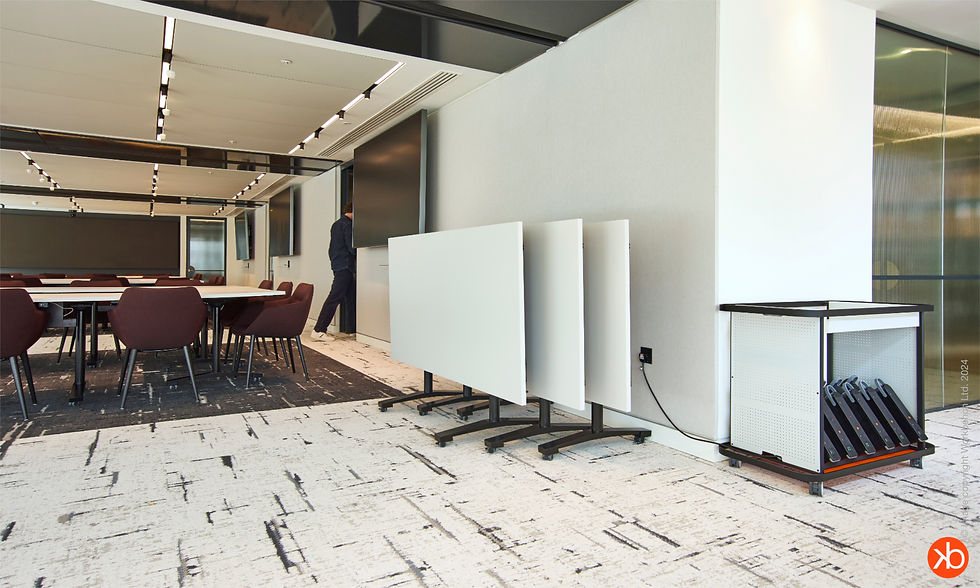
Air Atoll is Workbench's battery-powered, mobile flip-top meeting table system for flexible commercial spaces. Designed and manufactured by Workbench, Air Atoll combines rechargeable battery power, mobile flip-top functionality, linking configurations and integrated charging access.
Air Atoll was developed for commercial environments where fixed power infrastructure restricts how a space is used. The system is built around the Animate lithium battery system by Office Electrics, engineered to power laptops and mobile phones for hours at a time.
Recent refinements to the Air Atoll system include a revised battery orientation to optimise power delivery, optional folding modesty panels and streamlined power distribution to the table edge through fully integrated cabling. Discreetly mounted twin USB-C charging points or OE Piton power outlets come as standard. Furthermore, a double-column frame configuration supports table tops up to 3000 mm x 1500 mm, expanding the table's capabilities for larger boardrooms.
To complement the system, Workbench developed a dedicated mobile charging cart. This ensures a continuous supply of fully charged batteries that can be exchanged quickly and effortlessly, providing a highly practical charging workflow for facilities teams.
With finishes available in laminate, Fenix and veneer, Air Atoll gives commercial meeting spaces a practical way to support hybrid work without compromising the design intent.
How to specify a laptop charging table
When comparing powered meeting table options, specifiers should look beyond the battery itself. The complete system matters. Architects, interior designers and contractors should consider the following criteria:
Mobility and reconfiguration: Does the table feature a flip-top mechanism and high-quality castors? A mobile meeting table must be easy for a single person to move and store.
Battery management workflow: How are the batteries charged? Systems with swappable batteries and dedicated charging trolleys are vastly superior for day-to-day facilities management.
Power delivery: Ensure the table offers integrated USB-C power and adequate wattage to charge modern laptops, not just mobile phones.
Design and finishes: The table must look appropriate for a premium commercial fit-out. Look for tailored dimensions, concealed cable management and high-quality edge detailing.
Sustainability and lifecycle: Consider how the furniture supports long-term adaptability. By removing the need for disruptive infrastructure changes, cableless tables inherently support a more sustainable approach to office fit-outs.
Frequently asked questions about rechargeable tables
What is a battery-powered meeting table?
A battery-powered meeting table is a commercial table equipped with concealed lithium batteries that power users directly. This allows devices to be charged via USB-C or standard outlets without the table being plugged into a fixed mains connection.
How do you charge a cableless meeting table?
The most efficient systems use removable battery packs. Facilities teams can unclip the depleted batteries from the table and place them into a centralised, mobile charging cart. Fresh batteries are then swapped into the table, ensuring zero downtime for the meeting space.
Can you link mobile meeting tables together?
Yes. Premium systems like Air Atoll are designed to link together securely. This allows businesses to create large boardroom tables that can later be separated into individual desks for training or workshop configurations.
Are rechargeable meeting tables suitable for premium interiors?
Absolutely. While early iterations of powered furniture looked overly technical, modern systems now completely conceal the battery architecture. With bespoke finishes like veneer and Fenix, these tables are regularly specified for executive boardrooms and high-end commercial fit-outs.
Next steps for powering your flexible workspace
A cableless meeting table allows the room to adapt as the working day evolves, giving teams access to power without compromising the space's look or flexibility. As commercial offices continue to prioritise hybrid work, adaptable furniture will only become more critical to the success of an interior project.
Speak to Workbench about specifying Air Atoll for your next commercial workspace project. Our team is ready to support you with technical details, finish options and practical advice on integrating rechargeable power into your meeting spaces.
Furniture solutions by Workbench
Designed by us, tailored by you.
Discover more about Air Atoll here...