What Makes a Good Battery-Powered Table System?
A high-quality battery-powered table system integrates rechargeable power directly into commercial furniture, eliminating the need for fixed floor boxes. For a system to be fully resolved, specifiers must evaluate power access, battery exchange, charging trolleys, integrated cabling, and the long-term durability of the mobile meeting table.
Modern meeting spaces are expected to do more than host a single type of meeting. The same room may need to support board-level presentations, hybrid calls, training sessions, project work and collaborative workshops, often with different layouts across the same week.
That level of flexibility is difficult to achieve when power is tied to floor boxes, wall sockets, or visible mains cabling. Facilities managers and interior designers increasingly turn to battery-powered office furniture to solve this structural challenge. However, as more products enter the category, specifiers must look beyond simply adding a battery.
A single battery attached to a desk does not create a flexible workspace. To support demanding workplace environments, architects, FMs and procurement teams must specify a complete battery-powered table system that addresses power management, visual design and daily operational practicality.

Why do commercial workspaces need a complete battery-powered table system?
When a commercial interior relies on fixed power infrastructure, the room layout quickly becomes static. Moving a meeting table away from a floor box usually results in trailing cables, which introduce safety hazards and disrupt the clean aesthetic of a premium interior.
Cableless meeting tables solve this by delivering power directly to the furniture. This allows the room to adapt without compromising access to charging, the visual finish or the user experience.
However, the operational success of this furniture depends entirely on how the battery system is managed. A fully resolved battery-powered table system ensures that power is consistently available, easy to distribute to users, and simple for facilities teams to maintain throughout the working week.
What are the key features of a resolved battery-powered table system?
When comparing powered meeting table options, specifiers should carefully evaluate how the technology integrates with the physical furniture. The strongest powered meeting tables do not make technology the focal point. They integrate technology quietly, so the room remains visually clean and the table remains easy to use.
How does integrated cabling improve the user experience?
Providing power to the table is only the first step. The system must also deliver that power to the user efficiently. High-quality battery-powered table systems use concealed cable management to route power from the battery pack directly to the table edge or surface.
Discreetly mounted twin USB-C charging points or OE Piton power outlets allow users to charge laptops and mobile phones exactly where they are sitting. Integrated cabling prevents loose wires from forming beneath the table, protecting the equipment from damage when the mobile flip-top table is moved or reconfigured.
Why are exchangeable batteries critical for facilities teams?
A meeting room table is only useful if it is ready for the next meeting. If a table must be plugged into a wall to recharge, it loses its primary benefit as a flexible, cable-free solution.
A practical battery-powered table system relies on exchangeable batteries. When a battery pack runs low, facilities managers can simply unclip the depleted unit and slot in a fully charged replacement. This exchangeable system ensures that the meeting table experiences zero downtime and remains completely mobile at all times.
How do charging trolleys support battery management?
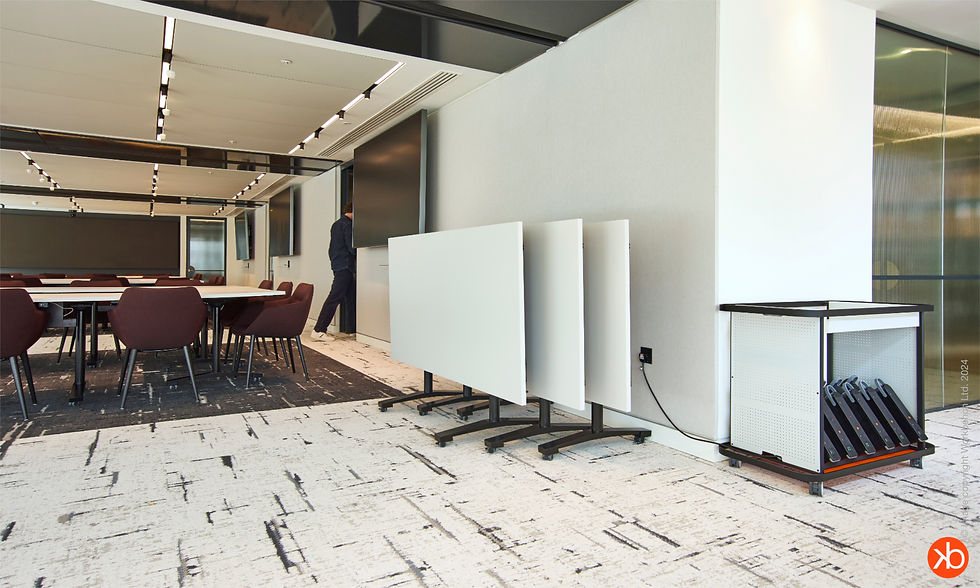
For commercial workspaces with multiple flexible meeting rooms, managing battery levels across different floors can become complex. A dedicated battery trolley is an essential component of a considered power management strategy.
A mobile charging cart allows facilities teams to transport, store and charge multiple battery units simultaneously. Specify a battery trolley if your facilities team manages several reconfigurable rooms, as this guarantees a continuous supply of replenished batteries without requiring staff to carry heavy units across large office spaces.
What role does finish quality play in premium interiors?
Battery-powered meeting tables must perform first as high-end commercial furniture and second as technology vessels. Executive boardrooms and client-facing meeting spaces require refined finishes that align with the broader architectural design intent.
A resolved system offers tailored dimensions and bespoke finishes, including premium veneer, Fenix and high-pressure laminates. The structural frame must provide absolute stability, especially when tables are equipped with linking mechanisms to form larger collaborative setups.
How does Air Atoll provide a fully resolved battery-powered table system?
Air Atoll is Workbench’s established battery-powered, mobile flip-top meeting table system for flexible commercial spaces. Designed and manufactured in Britain by Workbench, Air Atoll combines rechargeable battery power, linking configurations and integrated charging access to set a benchmark for contemporary meeting spaces.
The Air Atoll system is built around the highly regarded Animate lithium battery system by OE Electrics. This integration provides a proven, commercial-grade power source that supports laptops and other devices for extended periods without a mains connection.
Continuous refinement through real-world workplace use has shaped Air Atoll into a highly adaptable solution. Recent technical developments include a new double-column frame configuration that supports table tops up to 3000mm x 1500mm. Workbench has also introduced optional folding or demountable modesty panels, alongside a revised battery orientation that optimises power delivery and simplifies the exchange process for facilities teams.
With Air Atoll, specifiers receive a complete, considered system that includes the table, the integrated power architecture and the mobile charging cart required for effortless daily operation.
Specifier checklist for battery-powered meeting tables
When building a specification for a flexible meeting space, commercial specifiers should confirm the following criteria:
Power distribution: Does the table feature integrated USB-C charging at the user level?
Battery management: Does the system utilise exchangeable batteries to prevent table downtime?
Charging infrastructure: Is a dedicated battery trolley available to streamline facilities workflows?
Cable integration: Is the internal cabling fully concealed within the table frame?
Mobility: Does the table offer flip-top functionality and heavy-duty castors for easy reconfiguration?
Design quality: Can the manufacturer provide tailored finishes such as Fenix or veneer to suit premium interiors?
Frequently asked questions about battery-powered table systems
What should a battery-powered table system include?
A robust battery-powered table system should include reliable user power access (such as USB-C ports), rechargeable and replaceable batteries, concealed, integrated cabling, a mobile charging trolley for battery management, and durable, commercial-grade furniture design.
Why should architects specify a cableless meeting table instead of floor boxes?
Choose a cableless meeting table if flexible room layouts matter more than a static furniture arrangement. By removing the dependency on fixed floor boxes, architects allow commercial workspaces to adapt to different meeting styles without requiring disruptive and costly infrastructure changes.
Can mobile battery-powered tables connect to form larger boardroom tables?
Yes. Premium systems like Air Atoll feature dedicated linking mechanisms. This allows facilities teams to join multiple smaller mobile tables together to create a large boardroom setup, while still providing battery-powered charging access to every seated user.
How are batteries managed in a commercial office environment?
Facilities teams manage power levels using exchangeable batteries and a mobile charging cart. When a table's power runs low, a team member swaps the depleted battery for a fully charged unit from the battery trolley, ensuring the furniture remains operational and cable-free.
Speak to Workbench about specifying Air Atoll
A flexible meeting room is only truly adaptable if the furniture can move with it. By integrating rechargeable power, considered cable management and premium finishes, Workbench has created a system that supports the most demanding workplace environments.
Speak to Workbench about specifying the Air Atoll battery-powered table system for your next commercial workspace project.
Furniture solutions by Workbench
Designed by us, tailored by you.
Discover more about Air Atoll here...