Battery Pack vs Battery Cell: A Guide for Specifiers
A battery cell is an individual power storage unit, while a battery pack combines multiple cells into a complete, safe and manageable power source. When specifying commercial furniture, the focus must be on the entire battery pack and its integration into the wider table system.
Modern meeting spaces are expected to do more than host a single type of meeting. The same room may need to support board-level presentations, hybrid calls, training sessions and collaborative workshops, often with different layouts across the same week.
That level of flexibility is difficult to achieve when power is tied to floor boxes, wall sockets, or visible cabling. Battery-powered meeting tables solve this by bringing rechargeable power directly into the furniture, allowing the room to adapt without compromising access to charging.
As interest in battery-powered office furniture grows, architects, designers, and facilities teams frequently encounter terms such as "battery cell" and "battery pack" during the specification process. Understanding the technical distinction is important. However, the most critical factor for a commercial fit-out is how that technology is integrated into a practical, everyday workflow.
What is a battery cell?
A battery cell is the fundamental unit that stores electrical energy. In a lithium battery system, the cell is the electrochemical container that holds the energy. Individual cells are relatively small and generate only a few volts of power.
Because they are the raw components of energy storage, single battery cells are never used directly to power commercial office furniture. They require electrical management, physical protection and structural housing to operate safely in a demanding workplace environment.
What is a battery pack?
A battery pack is a complete enclosure that houses multiple battery cells. The pack links the individual cells together to achieve the required voltage and capacity for heavy commercial use.
A commercial battery pack includes integrated safety features, charging circuitry and an outer casing designed for daily handling. For example, the QIKPAC battery used within the OE Electrics Animate system is a fully resolved battery pack designed specifically for commercial furniture integration.
When specifying a rechargeable meeting table, you are always specifying a battery pack rather than a raw battery cell. The quality of the battery pack determines how safely the power is delivered, how easily the unit can be removed for charging and how reliably it performs in the long term.

Why is battery capacity only part of the specification process
Comparing battery-powered office furniture solely by battery capacity will not reveal how the table performs in a real commercial workspace. A high-capacity battery pack is useful, but the complete furniture system dictates the user experience.
Specifiers should look beyond the presence of a battery and consider power access, battery management, mobility and cable integration.
How does battery placement affect usability?
A battery pack must be accessible. Facilities teams need to swap depleted battery packs for fully charged units without disrupting the room layout or dismantling the furniture. The best systems mount the battery pack in a discreet yet easily accessible location for maintenance staff, keeping the table's visual lines clean.
What is the ideal charging workflow?
If a battery-powered meeting table needs to be taken out of action to be plugged into a wall, it fails as a flexible solution. Practical systems rely on a charging workflow that keeps the table in use.
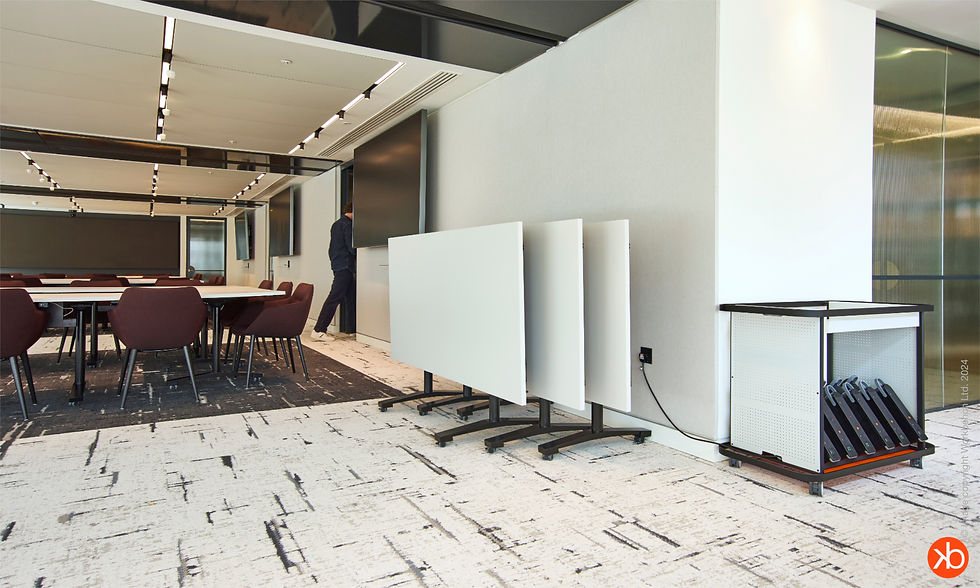
This workflow typically involves a mobile charging cart or docking station that keeps spare battery packs fully charged. Facilities managers can then exchange the battery packs in seconds, ensuring the meeting table is always ready for the next group of users.
How does integrated cabling manage power delivery?
Power must be routed safely from the battery pack to the user. A battery pack sitting under a table is unhelpful if users still have to reach under the surface to plug in their devices.
Properly resolved commercial furniture routes power through concealed cable management systems directly to the table edge. This delivers discreet USB-C charging points exactly where people need them, keeping the work surface clear of trailing cables.
Air Atoll: A complete battery-powered table system
Air Atoll is Workbench’s battery-powered, mobile flip-top meeting table system for flexible commercial spaces. It allows meeting rooms, boardrooms and training environments to access integrated power without relying on floor boxes, fixed mains connections or visible cabling.
Air Atoll is more than a table with a battery pack attached. It is a carefully engineered furniture solution built around the Animate lithium battery system by OE Electrics. Designed and manufactured by Workbench, Air Atoll combines rechargeable battery power, mobile flip-top functionality, linking configurations and refined finish options.
Recent enhancements to the Air Atoll system include a revised battery orientation to optimise power delivery, as well as streamlined power distribution to the table edge via fully integrated cabling. Twin USB-C charging points or optional OE Piton power outlets provide users with immediate, reliable access to power.
To support the table's day-to-day operations, Workbench developed a dedicated mobile charging cart. This ensures a continuous supply of fully charged battery packs that can be exchanged effortlessly, making it a highly practical solution for busy facilities teams.
Specifier checklist for battery-powered furniture
When evaluating a cableless meeting table for a commercial workspace, review the complete system by asking the following questions:
How are the battery packs removed and recharged by the facilities team?
Is there a dedicated charging cart available to support multiple tables?
How is power routed safely from the battery pack to the user?
Does the table provide integrated USB-C charging at the table edge?
Are the cables completely concealed to maintain a premium interior finish?
Can the tables link together seamlessly to support different room layouts?
Is the table designed and manufactured for long-term performance in a commercial office?
Plan your next commercial workspace with Workbench
Battery-powered meeting tables offer incredible freedom for commercial interiors. By understanding the underlying technology and focusing on fully resolved systems, specifiers can deliver flexible meeting spaces that look premium and work beautifully in practice.
Speak to Workbench about specifying Air Atoll for your next commercial workspace project. Our team can provide technical support, bespoke finish options and expert guidance on integrating rechargeable power into your meeting table specification.
Frequently asked questions
What is the difference between a battery cell and a battery pack?
A battery cell is a single unit of chemical energy storage. A battery pack is a managed enclosure containing multiple cells, with safety circuitry and a protective casing, designed to power commercial equipment safely.
How do you charge a battery-powered meeting table?
The most efficient way to charge a battery-powered meeting table is to remove the battery pack and place it in a dedicated charging cart. This allows facilities teams to immediately swap a depleted battery pack for a fully charged one, keeping the table in continuous use without tethering it to a wall socket.
Can battery-powered tables support full-day meetings?
Yes. A high-quality commercial battery pack, such as those used in the OE Electrics Animate system, is engineered to power laptops and mobile phones for hours at a time. The exact duration depends on the number of connected devices and their individual power draw.
Do battery-powered tables eliminate the need for floor boxes?
Yes. By bringing rechargeable power directly into the furniture, cableless meeting tables remove the dependency on floor boxes. This gives architects and designers the freedom to configure collaborative spaces without being restricted by fixed power infrastructure.