Cableless meeting tables for flexible workspaces
Updated: Jun 18
A cableless meeting table provides integrated rechargeable power without visible trailing cables or dependence on a fixed floor box. This allows commercial spaces to stay flexible, reconfigurable, and visually clean while ensuring users can easily charge laptops and devices anywhere in the room.
Modern meeting spaces are expected to do more than host a single type of meeting. The same room may need to support board-level presentations, hybrid calls, training sessions, project work, and collaborative workshops. Often, these different functions require completely different layouts across the same week.
That level of flexibility becomes difficult when power is tied to fixed infrastructure. When a room relies on floor boxes or wall sockets, the furniture layout is dictated by the building rather than the people using it.
Battery-powered meeting tables solve this challenge by delivering power directly to the furniture. This approach allows the room to adapt without compromising access to charging, the visual finish, or the user experience. For architects, designers, and facilities teams, a cableless meeting table offers a practical way to future-proof a commercial workspace.
What exactly is a cableless meeting table?
A cableless meeting table is a piece of commercial office furniture equipped with integrated rechargeable battery packs. Instead of relying on a constant mains connection, these tables store power locally and distribute it to built-in charging ports located on the table surface or edge.
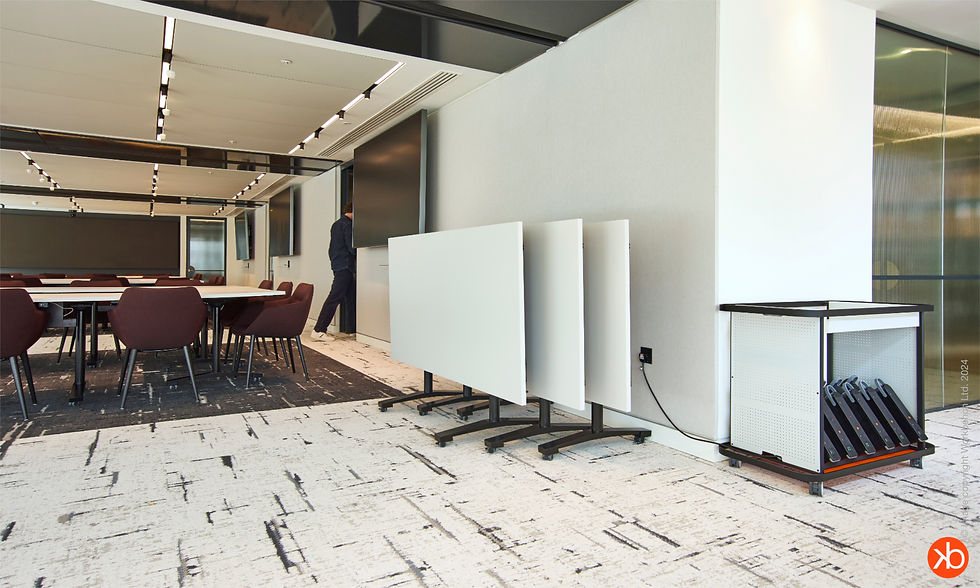
This means users can charge laptops, phones, and other devices directly from the table, completely independent of the building's electrical architecture. A fully resolved cableless meeting table system will typically feature concealed cable management, high-capacity lithium battery banks, and a dedicated charging trolley, ensuring facilities teams can easily swap and recharge batteries between meetings.
Why are commercial offices moving away from fixed power?
Historically, providing power to a meeting room meant installing extensive floor boxes and running cables under raised floors. While this works for static boardrooms, it creates significant limitations for a flexible commercial workspace.
Offices are moving away from fixed power because it restricts adaptability. If a company wants to convert a room from a formal boardroom setup to a collaborative workshop space, fixed floor boxes dictate exactly where the tables can be placed. Moving furniture away from these power sources inevitably leads to trailing cables, which create trip hazards and look untidy. Furthermore, installing or moving floor boxes requires disruptive and expensive construction work, which is often impossible in leased spaces or listed buildings.
How do cableless tables improve flexibility for meeting rooms, boardrooms, and training rooms?
A meeting room is only flexible if the furniture can move with it. By removing the dependency on a fixed mains connection, a cableless meeting table allows facilities managers and users to reconfigure a space in minutes.
For training rooms, tables can be arranged in a classroom style, grouped for team exercises, or pushed aside entirely. For boardrooms, linking configurations can create a large, unified surface for executive meetings. Because the power travels with the table, every user retains access to charging, regardless of where the table is positioned. This adaptable approach helps organisations maximise the utilisation of their commercial real estate.
Why is removing floor boxes and trailing cables important for premium interiors?
Design intent is easily compromised by poor power management. Clean lines, high-quality materials, and a sense of order characterise premium interiors. Trailing cables and visible extension leads instantly detract from the visual quality of a space.
By eliminating the need for trailing cables, cableless office furniture preserves the room's aesthetic integrity. Architects and interior designers can specify beautiful floor finishes without needing to interrupt them with brass or plastic floor boxes. The technology remains discreetly integrated into the table, ensuring the focus remains on the architecture and the bespoke furniture finishes.
How does integrated power put charging exactly where users need it?
The strongest powered meeting tables do not make technology the focal point. They integrate it quietly, so the room remains visually clean and the table remains easy to use.
When users sit down for a long meeting, they expect immediate access to power. A cableless meeting table delivers this by offering discreet USB-C charging or standard power outlets directly at the table edge. This proximity improves the user experience. Participants do not need to dive under the table to find a wall socket or stretch cables across the work surface. The power is simply there, ready to support hybrid work and continuous productivity.

What should architects and facilities managers include in a specification checklist?
When specifying a battery-powered meeting table, the presence of a battery is only one part of the decision. Power access, battery management, mobility, cable integration, and finish quality all shape whether the table will perform in a commercial setting. Specifiers should consider the following criteria:
Battery management: How are the batteries charged? Look for systems with a mobile charging trolley to keep replacement batteries ready
Mobility and linking: Does the table feature lockable castors and a mobile flip-top design for easy storage? Can multiple tables link together securely?
Power distribution: Are the USB-C charging ports and power outlets positioned conveniently for users without cluttering the surface?
Material and finish options: Can the table be tailored with veneer, Fenix, or laminate to match the broader design intent of the fit-out?
Sustainability and lifecycle: Is the table designed for long-term performance? Can components be easily replaced to extend the product's life?
How does the Air Atoll system support flexible commercial workspaces?
Air Atoll is Workbench's battery-powered, mobile flip-top meeting table system designed for flexible commercial spaces. It allows meeting rooms, boardrooms, and training environments to access integrated power without relying on floor boxes, fixed mains connections, or visible trailing cables.
Designed and manufactured by Workbench, Air Atoll combines rechargeable battery power, mobile flip-top functionality, linking configurations, and integrated charging access. It uses the Animate lithium battery system by OE Electrics, ensuring safe and reliable power delivery. The system is supported by a dedicated mobile charging cart, allowing facilities teams to exchange batteries quickly and effortlessly. With refined finish options and robust British manufacture, Air Atoll is an established and proven benchmark for cableless commercial workspaces.
Frequently asked questions about cableless meeting tables
How much does a cableless meeting table cost compared to traditional tables?
While the initial investment in a battery-powered meeting table is higher than a standard table, it often reduces overall project costs by eliminating the need for expensive floor box installations and electrical contractor work.
What is the timeline for specifying and installing a battery-powered table system?
Because there is no fixed infrastructure required, installation is incredibly fast. The lead time is primarily determined by the manufacturing of bespoke furniture, which typically aligns with standard commercial fit-out schedules.
What are the operational risks of using battery-powered office furniture?
The main operational risk is battery depletion during use. This is mitigated by specifying a complete system, such as Air Atoll, which includes a charging trolley and easily swappable battery packs to ensure a continuous power supply.
What are the alternatives to a completely cableless meeting table?
Alternatives include tables with integrated power that require a single mains connection (plug-and-play), or traditional tables that rely entirely on floor boxes. Choose a cableless meeting table if absolute room flexibility and visual cleanliness matter more than continuous, unmonitored mains power.
Who is a battery-powered meeting table designed for?
These tables are designed for commercial offices, training centres, and flexible workspaces where room layouts change frequently, and fixed power infrastructure is either impractical, too restrictive, or architecturally prohibited.
Speak to Workbench about your next workspace project
A cableless meeting table allows the room to adapt as the working day evolves, giving teams access to power without compromising the space's look or flexibility.
Explore Air Atoll for cableless meeting rooms, boardrooms, and flexible workspaces. Contact Workbench for support in configuring a battery-powered meeting table system for your next commercial project.